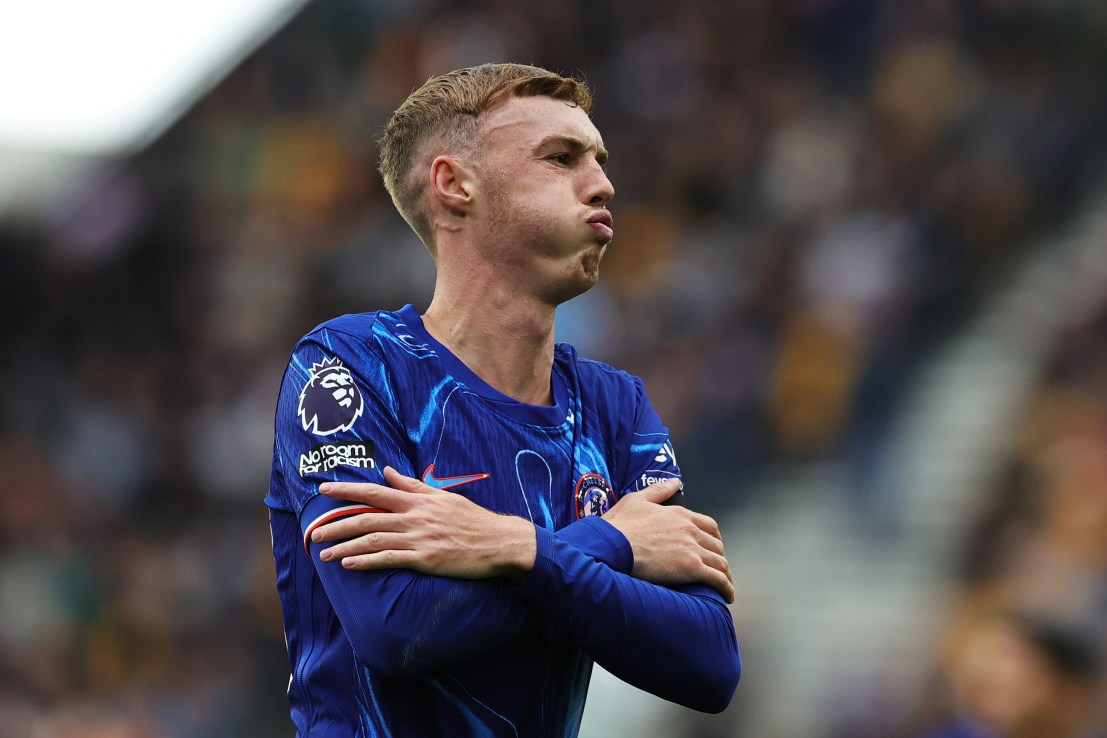
With Cole Palmer set for the Fifa World Cup this summer, why did he choose to trademark his Cold Palmer celebration? City AM asked the team behind the move.
“Intellectual property: intangible property that is the result of creativity, such as patents, copyright or other,” the Oxford Dictionary says. It’s something we’d expect to be associated with well-known businesses and company slogans, not football players’ celebrations.
But top flight sport is big business – Department of Culture, Media and Sport data suggests professional and community sport contributes around £100bn per year in economic output across the UK – and its stars create the iconic moments.
One of those came more than 800 days ago, in Chelsea’s 3-2 victory over Luton Town in the Premier League, when summer signing Cole Palmer unveiled his now-famous “Cold Palmer” goal celebration.
He wasn’t the original creator, however; Palmer admitted he’d taken inspiration from former Manchester City academy teammate Morgan Rogers, while Washington Wizards point guard Trae Young had been doing the shiver for years in the NBA during his Atlanta Hawks days.
But here in the UK, Palmer owns the intellectual property thanks to IP and sports lawyers Carol Couse and Alex Newman of Mills and Reeve, and brand consultant Dan French – the team behind the trademarking move.
Cold Palmer asset
“It’s about control over what we call personal brand assets,” Newman tells City AM. “And that control is exercised in a way which basically generates risk for unauthorised users of personal brand assets.”
Adds Couse: “[With Cole], it’s evolved over time. We initially started with advising on playing contracts and then as his stock has risen, more commercial deals come.
“It felt like there was real momentum building in terms of reaching a point at which we felt that it was appropriate to protect those brand assets. And so then we had the conversation about registering or applying for trademark registrations and then built that portfolio over a period of time.”
French says that Palmer’s goal for England in their 2024 Euros final defeat and his performances at last year’s Club World Cup have enhanced his notoriety, pointing out that YouGov ranked him sixth in a list of contemporary players behind the likes of Lionel Messi, Harry Kane, Cristiano Ronaldo and Chloe Kelly: “There was cultural momentum for it.”
Not as easy as it looks
But the world of trademarks and intellectual property in football isn’t new, and it is not always rosy either. Liverpool FC failed in an audacious bid to trademark the word “Liverpool” back in 2019 while reports last year suggested Palmer himself faced a battle with high-end French vineyard Chateau Palmer over the use of “Cold Palmer”.
Palmer tells City AM that Mills and Reeve “think outside the box and have recommended ways to protect my image and brand that are forward-thinking”.
But as Palmer has said himself, he did not originate the celebration. So how can he claim to own it?
Newman explains: “To be able to get protection of a particular brand asset as a registered trademark, there are certain criteria which have to be met.
“It’s not just the case of willy-nilly. Anybody can apply for a registered trademark for a name or a likeness or a goal celebration and be granted that registration. There is a process with the relevant intellectual property offices of scrutiny, of examination, to ensure that the brand assets in question meet the relevant criteria.
“And the criteria is that the brand asset in question has to be distinctive or capable of being distinctive of the owner of the registered trademark, and that it will be the use of that personal brand asset will be recognised by the public as a badge of either origin or control.”
Palmer synonymous with shiver
Couse adds: “We act for a lot of players and there’s definitely more interest in registration of trademarks, in building up that trademark portfolio, now than there ever has been.”
Football is big business but trademarks and intellectual property go way beyond the boundaries of the pitch; only last week Luke Littler registered his face as a trademark in a battle against AI deepfakes.
Palmer’s ability to succeed in trademarking a celebration that he didn’t create because he is, undisputedly, so synonymous with it is a lesson in getting on the wagon early and protecting a brand. Or someone else will get there first.





