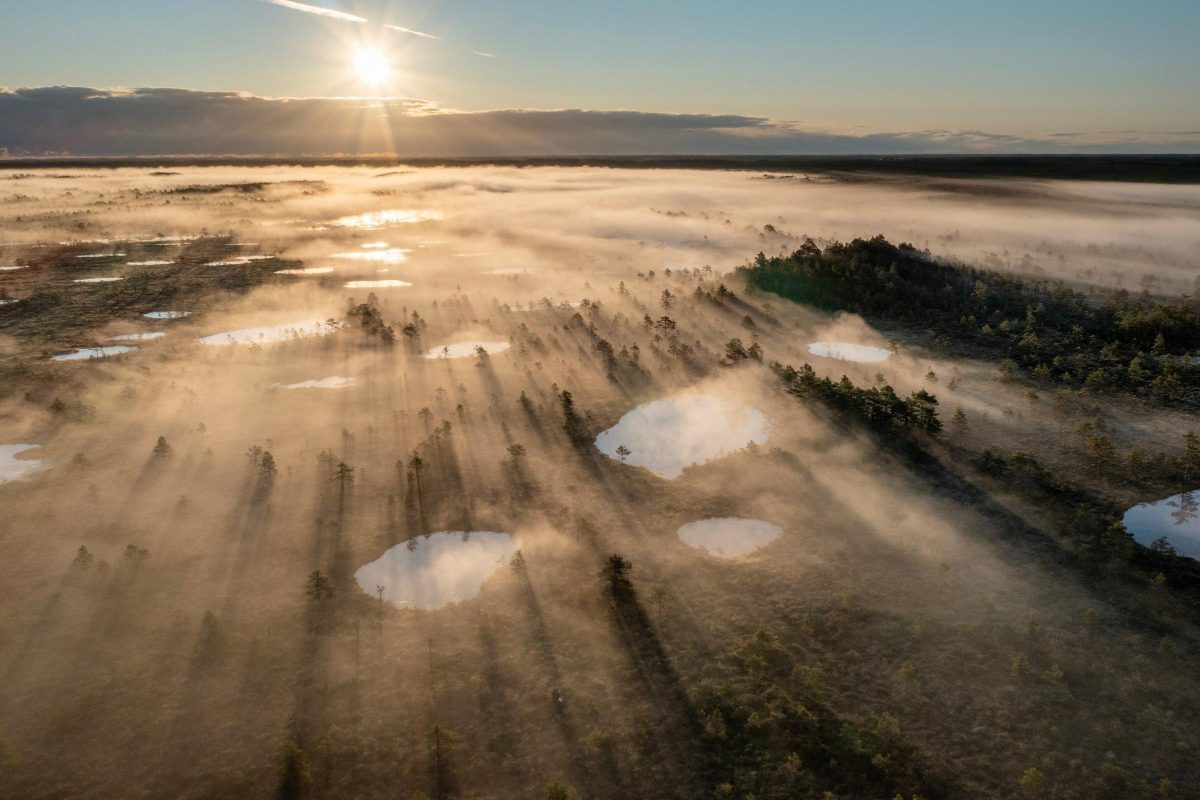
I am a Princess Fiona seeking her Shrek. My best chance of finding my lonely yet loveable ogre and getting our long-overdue Happily Ever After, as every DreamWorks fan knows, is in a swamp. Hackney Marshes and Walthamstow Wetlands have thus far failed to deliver the requisite calibre of hero, so this summer I headed further afield.
My swampy destination? Haraka Bog in Kõrvemaa, an appropriately wet landscape an hour outside Tallinn, a place where Estonia’s flag mirrors the white sky, blue water, and blackness of the soil.
Choose your bog
Estonia is famously flat. It is a country of coastal plains and open skies, which makes Kõrvemaa feel like a secret that the Earth has been keeping to itself. Protected forest, bogs and mires, eskers, valleys and still forest lakes – this is the landscape of fairytale where any kind of magic could happen. As we walked through the valleys and between the pine trees, my forest guide, Marilin Pehka, kept repeating: “Be silent. Nature is already telling you what you need to hear. You are already having a conversation with it.”
Bogs are ecosystems where organic plant matter does not fully decompose but is deposited as peat. They are climate change fighting miracles, trapping carbon for 10,000 years or more. And although bogs and swamps might have a bad reputation for being dirty or smelly, nothing could be further from the truth: they are complex, well-balanced habitats, rare and beautiful wetlands where specialised plants and ground birds thrive.
With an overcast sky, the water in Haraka Bog looked metallic and dark, with ripples circling out from the occasional plops or rain. I had clomped in blue plastic boots along the narrow boardwalk through the forest, listening to the wind shaking the trees and to the occasional twittering of the birds. And as I walked, I prepared mentally to strip everything off and surrender myself to nature. It wasn’t as if there were many spectators around.
It was bracingly cold, but my heart rate quickened and my mind became enlivened, too. It felt as if it were not just clothes that I had shed. With all my layers off, I could completely let go, swimming in the middle of the bog, in light rain, completely naked. With bog swimming, it seems that Estonians understand how to fully experience nature, that if you approach the water, or the forest, naked, vulnerable, and in your most natural state, you can be reborn time and again and face the world anew.
How to sauna in Estonia
Uuejärv Nature Retreat is on a nature reserve which was previously a Soviet-era military training base. Its rustic sauna is heated by a wood-burning stove. During a guided sauna session you experience vihtlemine, the practice of beating one’s own body with bundled birch or oak leaves, which boosts circulation and is certainly invigorating.
Where to stay
Accommodation inside Kõrvemaa is sparse. I stayed in one of the Kuuse Concept Houses (kuusemajad.ee), set within dense spruce and pine forest near the Sportland Kõrvemaa Hiking and Ski Resort. The cabins are built in a Scandinavian style that does not so much sit in the forest as belong to it, with floor-to-ceiling glass walls that dissolve the boundary between inside and out. You wake up to trees. You fall asleep to trees. The only sounds are the ones the forest makes, the creak of branches and whatever is moving through the undergrowth outside.
What to eat
Chef Ellery Powell might be Norfolk-born and -bred, but he moved to Estonia more than a decade ago, and he pays tribute to his adopted homeland in each meal he cooks for guests staying at the Concept Houses. He sources every ingredient within a 50 km radius in Körvermaa, and, often, from much closer: I picked golden chanterelles (kukeseen) on my walk in the forest, and Ellery sauteed them in butter before me. He also treated me to salmon tartare, carefully wrapped under an umbrella of Estonian clover; and seabass with a white wine sauce, sprinkled in dill.
To understand a culture, you have to indulge in its cuisine. Food will mend the cracks whenever language is a barrier. And Ellery speaks ‘Estonian cuisine’ very well.