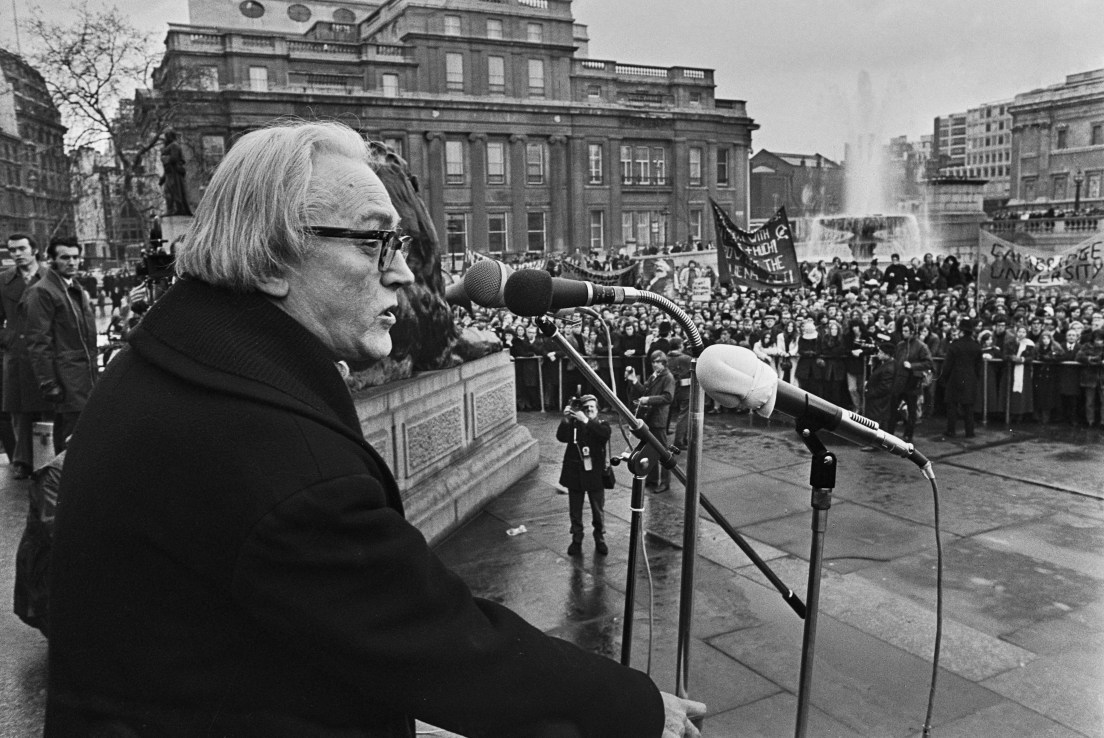
On 23rd July 1913, Michael Foot was born. He would go on to become a Labour leader known for his eloquence, his rigid socialist ideology and his jackets. What lessons does his career offer for Andy Burnham? Asks Eliot Wilson
Michael Mackintosh Foot was born on this day in 1913 in Plymouth. He would rise, eventually, to be leader of the Labour Party, but his tenure lasted less than three years – and he led the party into a single general election in 1983. Labour lost disastrously, its avowedly socialist manifesto dubbed by one of its own Shadow Cabinet “the longest suicide note in history”.
Foot was born into a different world. He would be the leader of a major British political party to have been born before the First World War, when the Labour Party as an organisation was not yet 10 years old.
Isaac Foot, a 33-year-old solicitor and Liberal councillor, and his politically active wife Eva, already had three sons and a daughter when Michael was born. Isaac was a strict Methodist who had honed his public speaking in the chapel. Having left school at 14, he was a ferocious autodidact, an avid book collector and steeped in the history and creed of West Country radicalism. Michael would have no need to teach himself, but he was the only one of an eventual seven children who would inherit Isaac’s passion for books, and radicalism would never be a problem.
Foot was educated at a local prep school then Leighton Park, a Quaker school in Reading. He went up to Wadham College, Oxford, as an exhibitioner in 1931 to read philosophy, politics and economics, and became a successful and well-known face in student politics. Like brothers Dingle and John, he was President of the Liberal Club and, also like them, President of the Oxford Union in Michaelmas term 1933.
Graduating with a second-class degree in 1934, he became a shipping clerk at the Blue Funnel Line in Birkenhead. The Depression-era poverty he saw on Merseyside appalled him: with unemployment at 30 per cent in some places, families were crowded into damp, insanitary tenement slums, and chronic malnutrition, rickets, pneumonia and bronchitis were rife. Local author Helen Forrester described Liverpool as a city “which seemed to be slowly dying”.
In 1935, Foot joined the Labour Party, which had been reduced to just 52 seats at the 1931 general election, and in that year’s contest, at 22, he stood in Monmouth, a safe Conservative seat. He lost by nearly 10,000 votes, but it had fired some spark inside him. He took up journalism, first at The New Statesman as it tacked leftwards and began to venerate Stalin, then at the newly established Tribune. The latter was set up by Labour MPs Sir Stafford Cripps and George Strauss, and Aneurin Bevan was a board member. Bevan would become his mentor, friend and prophet, though they fell out badly over nuclear disarmament.
Although Foot left Tribune in 1938, he had now found his political identity, well to the left of mainstream Labour. He was fiercely anti-imperialist and a strong supporter of the India League and defined himself as a libertarian socialist.
In 1945, Foot was Labour’s candidate in Plymouth Devonport, long a Conservative/Liberal battleground. With a 22-point swing to Labour he unseated the former Minister of Transport Leslie Hore-Belisha, of traffic crossing fame. He moved to The Daily Herald, part-owned by the Trades Union Congress, before returning to Tribune in 1948 for four years as editor.
A golden generation
The new Labour MPs formed an impressive cohort: Hugh Gaitskell, Harold Wilson, Jim Callaghan, Barbara Castle, George Brown, Richard Crossman. Four would reach Cabinet by 1951. But there was no whiff of ministerial office. He was a firebrand, a gadfly – eloquent, principled, radical but never required to dirty his hands with practical politics. He was unexpectedly defeated in Plymouth in 1955 and took up the editorship of Tribune again, but in 1960 returned to the Commons for Ebbw Vale at a by-election caused by his friend Nye Bevan’s early death.
Foot turned down a Cabinet post in Harold Wilson’s 1964 government and remained a watchful critic from the backbenches, opposing trades union reform, entry to the Common Market, restrictions on immigration and, in an unlikely partnership with Enoch Powell, Wilson’s proposed changes to the House of Lords; it would be, he said witheringly, “a seraglio of eunuchs”. By 1974, however, when an already-exhausted Wilson returned to Downing Street, Foot accepted the position of employment secretary.
At the Department of Employment, Foot’s primary role was to appease the trades unions; repealing the Heath-era union legislation and introducing measures to safeguard workers did just that. But his temperament was neither that of the turn-on-a-sixpence attack dog, nor of the great administrator. When Wilson resigned in 1976, Foot stood for the leadership and came a surprisingly close second with 44 per cent of the votes; the new Prime Minister, Jim Callaghan, moved him to be leader of the House of Commons.
The government fell in March 1979. Foot, winding up the confidence debate that evening, gave one of his best performances in the House, but the door was now open for the Conservatives and Margaret Thatcher’s handbag pushed it wide. Callaghan stayed on as Labour leader for 18 months, hoping to provide stability for the party. It did not work. The left was stronger than ever, while some on the right were eyeing the exits.
Callaghan wanted Denis Healey, the former Chancellor and Labour’s most formidable figure, to succeed him, but the left largely coalesced around Foot. He won the backing of Labour MPs by 10 votes.
Michael Foot was 67 years old. The Prime Minister, Margaret Thatcher, had her own internal party strife, though it largely died away after the Falklands conflict, while Foot needed somehow to reunite the fissiparous Labour Party and plan how to win a general election.
It was a difficult task, made more difficult when 28 Labour MPs ended up leaving to join the SDP. For Foot it was probably impossible. He was undoubtedly a brilliant speaker, less stern and hectoring than Thatcher and certainly funnier. But he was wedded to a rigid socialist agenda that voters simply didn’t want: widespread nationalisation of industry, unilateral nuclear disarmament, withdrawal from the EEC. Labour was effectively telling the electorate that the woes of the 1970s had been caused by too little socialism, not too much.
Foot did not look like a Prime Minister in waiting. He was accident-prone – sometimes literally – and walked with a stick after a car accident in the 1960s. His unkempt white hair led to comparisons with Wurzel Gummidge, and an unremarkable but short overcoat he wore at the Cenotaph was labelled a donkey jacket. Once an economic recovery began, squeezed between the Conservatives and the SDP-Liberal Alliance, Labour had little to offer. The 1983 general election saw Foot’s party win just 208 seats, and its vote share of 27 per cent was only two points ahead of the Alliance.
Turning 70 six weeks after polling day, Foot naturally resigned and Labour elected Neil Kinnock to begin its long, 14-year fightback to office. Foot remained an MP until 1992, and died in 2010, aged 96. He remained a cautionary tale for Labour: ideological purity, advancing age and eccentric dress do not win general elections: a lesson the party chose to forget in 2015, when it elected Jeremy Corbyn.
Foot was a different calibre. An acute mind, an eloquent and elegant speaker, a deep literary hinterland and a profound identification with the roots of English radicalism. But, to coin a phrase, no Prime Minister.
Eliot Wilson is a writer and historian





